Category: Blog
-
DepLeadtership
Leaders burn out, a LOT. We cannot do great good for others if we do not take care of ourselves. If we deplete ourselves, we and many that depend on us pay a price.
Just as we are responsible for the health and wellbeing of our stakeholders — internal and external — we are also responsible for our own.
That means attending to our own health and wellbeing on three fronts: 1) Intellectual/Cognitive, 2) Physical, and 3) Emotional/Spiritual.
Knowing who we want to be has everything to do with how we take care of ourselves. If we do not embed habits of self-care into our daily lives as leaders, we will most certainly burn out (or in some cases, burn “through”). With that, our opportunity to leave the world a better place is lost.
TODAY is a good day to abandon bad habits related to self-care. TODAY is also a good day to adopt some healthy ones.
*If you’d like read more of nc’s blathering, go to nc’s Resursive Learning.
-
LeadershipVulnerability
Two of the hallmarks of exemplary leadership are Vulnerability and Transparency.
Being Vulnerable as leaders does not make us “wobbly” (to channel Margaret Thatcher). On the contrary, it positions us to more authentically engage with both our internal and external stakeholders.
Vulnerable Leaders look/feel/sound like this:
They openly share what they DON’T know, expressing a deep desire to learn more (from whomever and wherever that learning can emerge).
They know they can’t do it all, and thus, freely ask for help from others.
They LEARN constantly, which signals to others that continual learning is both OK and an expectation.
They model that leadership compels one to be a servant, not a master.
They emanate the understanding that we are all intertwined and interdependent on one another.
When I was pretending to be an athletic coach (decades ago), I noticed that the preponderance of the individual accolades that flowed once a season was over went to those athletes on successful TEAMS.
We, as individuals, are most successful when we are contributing team members. Leaders are only one component of the TEAM. Being a Vulnerable Leader accelerates TEAM performance.
*If you’d like to read more of nc’s blatherings, to to nc’s Recursive Learning. -
WhoBe
Author: Nelson Coulter
Who we choose to BE is far more important than what we choose to do, and orders of magnitude more important than what we say.
How do we go about choosing who we want to BE?
An impactful guiding question: How will my existence on the planet make it a better place for ALL people?
Once that question has been carefully examined, we can begin scheduling our days/weeks/months/lives. Focusing our time, effort, and resources on the truly important things is the ONLY thing that moves us closer to who we want to BE.
And tomorrow……we ask that question of ourselves again.
Get better. Everyday. On purpose.
*If you’d like to read more of nc’s blatherings, go to nc’s Recursive Learning. -
HelpTest
A valued friend of mine shared a lovely concept with me this week. (I’ll call him Bob for purposes of anonymity.)
Bob told me that he had been advised at a young age by valued mentor to take the following approach to life:
Whenever you have the opportunity to help someone, take it. For it may never come around again.
Yeppers. A simple tenet to make the world a better place.
We could begin today…
*If you’d like to read more of nc’s blatherings, go to nc’s Recursive Learning.
-
CoddlingOfTheAmericanMind
I recently read The Coddling of the American Mind: How Good Intentions and Bad Ideas are Setting Up a Generation of Failure, byGreg Lukianoff and Jonathon Haidt (2018).

In this is book, Lukianoff and Haidt premise what they call the three Great Untruths:
1) The Untruth of Fragility: What doesn’t kill you makes you weaker;
2) The Untruth of Emotional Reasoning: Always trust your feelings; and
3)The Untruth of Us Versus Them: Life is a battle between good people and evil people.
My top takeaways:
- “Untruths” contradict ancient wisdom, contradict modern psychological research on well-being, and harm individuals and communities.
- There is great wisdom in the old saying: “Prepare the child for the road, not the road for the child.”
- There are two kinds of identity politics: Common-Humanity (unifying approach) and Common-Enemy (divisive approach).
- Words areNOT violence, and telling our children so is not healthy.
- Definition of Witch Hunt: they seem to come out of nowhere; they involve charges of crimes against the collective; the offenses that lead to those charges are often trivial or fabricated; and people who know that the accused is innocent keep quiet, or in extreme cases, they join the mob.
- The loss of Free Play time is exacting a heavy and detrimental price on the socio-emotional development of our children.
- Two common conceptions of justice: 1) Distributive justice (the perception that people are getting what is deserved), and 2) Procedural justice (the perception that the process by which things are distributed and rules are enforced is fair and trustworthy).
- Four rules for productive disagreement: 1) Frame it as a debate, rather than a conflict. 2) Argue as if you’re right, but listen as if you’re wrong (and be willing to change your mind). 3) Make the most respectful interpretation of the other person’s perspective. 4) Acknowledge where you agree with your critics and what you’ve learned from them.
My favorite quotes:
“… wind extinguishes a candle but energizes a fire.” (p.23)
“A culture that allows the concept of “safety” to creep so far that it equates emotional discomfort with physical danger is a culture that encourages people to systematically protect one another from the very experiences embedded in daily life that they need in order to become strong and healthy.” (p.29)
“Mass movements can rise and spread without belief in a God, but never without belief in a devil.” -from Eric Hoffer, in The True Believer (p.99)
“Free play helps children develop the skills of cooperation and dispute resolution that are closely related to the “art of association” upon which democracies depend. When citizens are not skilled in this art, they are less able to work out the ordinary conflicts of daily life. They will more frequently call for authorities to apply coercive force to their opponents. They will be more likely to welcome the bureaucracy of safetyism.” (p.194)
While Lukianoff and Haidt get into the weeds a little prescriptively toward the end of the book, I found the premise of their arguments to be sound and consistent with my societal observations.
This is a book I’m thankful to have read. And, I’m thankful that my grandchildren are being raised by parents and educators who are teaching them that life is what we make of it, not what happens to us.
*If you’d like to read more of nc’s blatherings, go to nc’s Recursive Learning.
-
The Drumbeat of Excellence
As a small, rural school superintendent, my primary goal is to ensure that excellence and continuous improvement resonates throughout our district. To achieve this, I employ a structured approach that focuses on collaboration, innovation and a commitment to student success and achievement.
Strategic Vision: At the core of our efforts is a well-defined strategic vision. Our vision was developed in collaboration with various stakeholders, including teachers, parents, and community members. This vision serves as our roadmap to our district’s future.
Data-Driven Decision Making: We continually emphasize the importance of data in driving our decisions and student achievement efforts. Regular assessments are conducted to gauge student performance, teacher effectiveness, and overall district progress.
Professional Development: Continuous improvement begins with our educators, all of them. We invest in ongoing professional development opportunities and coaching for teachers and staff. This provides them with the most research-based, highly effective teaching methods and technologies.
Resource Allocation: When considering our budget, we allocate resources wisely, directing funds to areas where it will have the most impact on student achievement. We maintain fiscal responsibility while ensuring that our schools have the necessary resources to succeed.
Innovation and Adaptation: We continuously encourage innovation in teaching and learning. Our district stays current with educational research and trends and adapts to meet the ever-evolving needs of our students.
Recognition and Celebration: We celebrate the achievements of our students, teachers, and staff. Recognizing and rewarding excellence creates a positive culture of success within our district.
In summary, the structure of my work as a small, rural school superintendent is built on a foundation of collaboration, data-driven decision-making, and a commitment to continuous improvement. By maintaining transparency, celebrating achievements, and fostering innovation, we ensure that the drumbeat of excellence echoes throughout our district, inspiring our students to reach their fullest potential.
-
Recalcitrant
Sometimes we slip into recalcitrant thinking and behavior. The impact of such behavior is defensive, limiting, and “slowing.” That impact is especially magnified when the recalcitrance comes from leadership.
What does recalcitrance look like in an organization?
- Impose layer upon layer of permissions and approval for menial tasks.
- Talk about data but rarely examine the data with a skeptical and open mind.
- Discourage risk taking and risk takers.
- Limit professional development and/or organizational learning.
- Stay focused on the day-to-day actions rather than on the BIG espoused outcomes.
- Harden the protocols/rules/procedures.
- Listen and talk only to the internal stakeholders.
Where recalcitrance rules, obsolesce — or irrelevance — soon follows.
Anti-example can be a powerful teacher.
*If you’d like to read more of nc’s blatherings, go to nc’s Recursive Learning.
-

Support of a $500K Grant From the Catalyze Challenge
[et_pb_section fb_built=”1″ _builder_version=”4.21.0″ _module_preset=”default” da_disable_devices=”off|off|off” global_colors_info=”{}” theme_builder_area=”post_content” da_is_popup=”off” da_exit_intent=”off” da_has_close=”on” da_alt_close=”off” da_dark_close=”off” da_not_modal=”on” da_is_singular=”off” da_with_loader=”off” da_has_shadow=”on”][et_pb_row _builder_version=”4.21.0″ _module_preset=”default” global_colors_info=”{}” theme_builder_area=”post_content”][et_pb_column type=”4_4″ _builder_version=”4.21.0″ _module_preset=”default” global_colors_info=”{}” theme_builder_area=”post_content”][et_pb_text _builder_version=”4.21.0″ _module_preset=”default” global_colors_info=”{}” theme_builder_area=”post_content”]
With the support of a $500K grant from the Catalyze Challenge, the program has scaled its P-20 program in the past year to serve nearly 16,000 rural students, across 16 districts statewide. Students attain a college degree, industry-based certifications, and a work-based learning experience.
One local anecdote of success is the partnership between Hamlin Collegiate High School District, Cisco College, and local HVAC employer Cary Services which is building a robust classroom to career pipeline to meet the community’s workforce needs. CEN sponsors the Registered Apprenticeship Program and recently celebrated Joey Cook, a graduate of the program who is now the first HVAC apprentice.
With more families moving rurally, HVAC contractors are in demand and we’d appreciate the opportunity to work with you on a story so that the community is aware of this opportunity to train and grow the Rural Texas Workforce.[/et_pb_text][et_pb_image src=”https://dev.edu-nation.org/wp-content/uploads/2023/09/image001-1.jpg” _builder_version=”4.21.0″ _module_preset=”default” theme_builder_area=”post_content” title_text=”image001 (1)” hover_enabled=”0″ sticky_enabled=”0″][/et_pb_image][/et_pb_column][/et_pb_row][/et_pb_section]
-
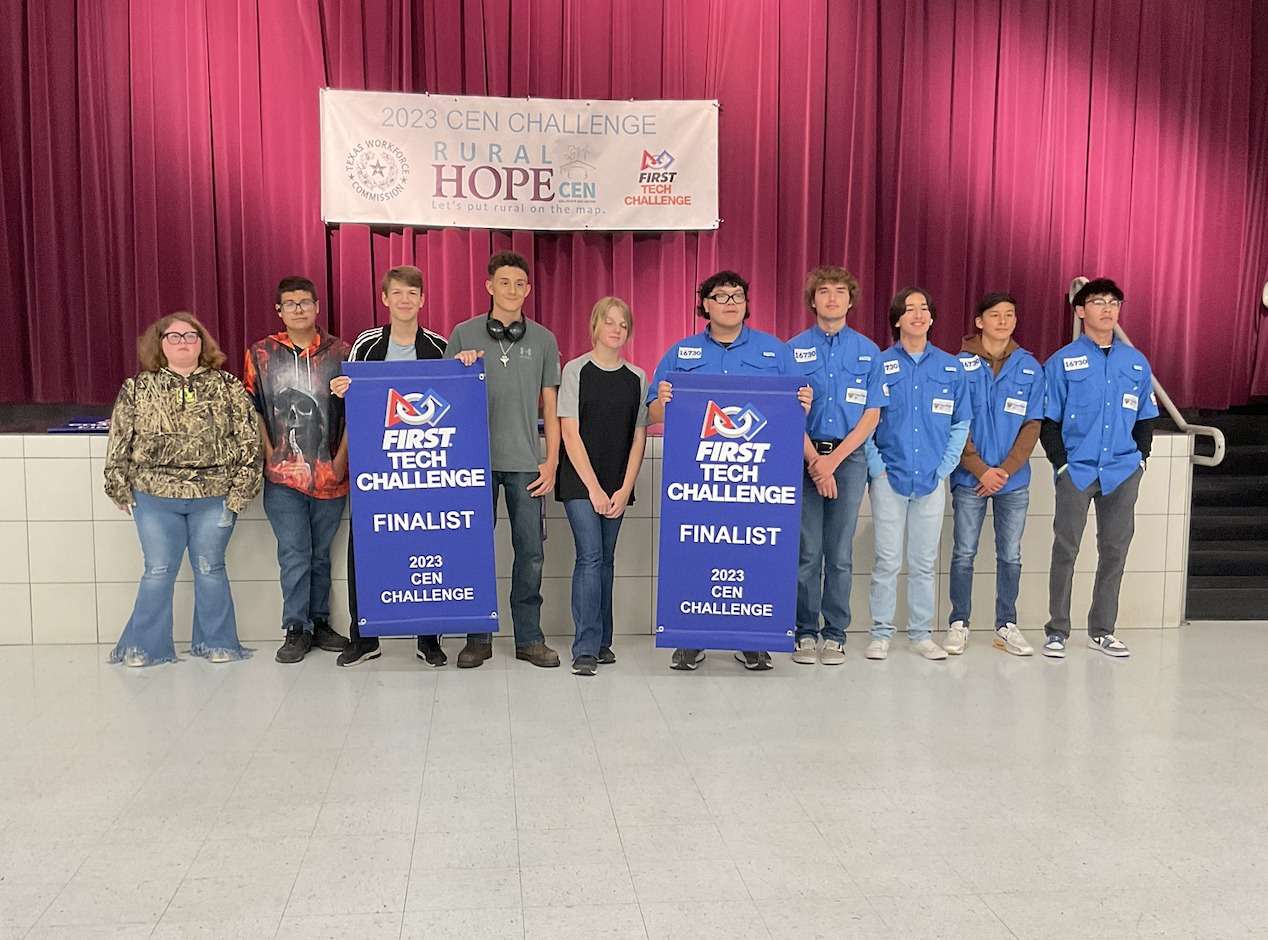
We Hosted the Inaugural CEN FIRST Robotics Challenge at Roscoe Collegiate ISD.
[et_pb_section fb_built=”1″ _builder_version=”4.21.0″ _module_preset=”default” da_disable_devices=”off|off|off” global_colors_info=”{}” theme_builder_area=”post_content” da_is_popup=”off” da_exit_intent=”off” da_has_close=”on” da_alt_close=”off” da_dark_close=”off” da_not_modal=”on” da_is_singular=”off” da_with_loader=”off” da_has_shadow=”on”][et_pb_row _builder_version=”4.21.0″ _module_preset=”default” global_colors_info=”{}” theme_builder_area=”post_content”][et_pb_column type=”4_4″ _builder_version=”4.21.0″ _module_preset=”default” global_colors_info=”{}” theme_builder_area=”post_content”][et_pb_text _builder_version=”4.21.0″ _module_preset=”default” hover_enabled=”0″ global_colors_info=”{}” theme_builder_area=”post_content” sticky_enabled=”0″]
We had the pleasure of hosting the inaugural CEN FIRST Robotics Challenge at Roscoe Collegiate ISD.
A total of 9 teams competed from Venus ISD, Sunray Collegiate ISD, Floydada Independent School District, Spurger ISD, Hico Independent School District, and Hamlin Collegiate Independent School District, AND the CEN Unified team comprised of special needs students.
Keep up the good work![/et_pb_text][et_pb_image src=”https://dev.edu-nation.org/wp-content/uploads/2023/09/347563778_266503549176747_7287440011365255801_n.jpg” _builder_version=”4.21.0″ _module_preset=”default” theme_builder_area=”post_content” hover_enabled=”0″ sticky_enabled=”0″ title_text=”347563778_266503549176747_7287440011365255801_n”][/et_pb_image][/et_pb_column][/et_pb_row][et_pb_row _builder_version=”4.21.0″ _module_preset=”default” theme_builder_area=”post_content” column_structure=”1_2,1_2″][et_pb_column _builder_version=”4.21.0″ _module_preset=”default” type=”1_2″ theme_builder_area=”post_content”][et_pb_image src=”https://dev.edu-nation.org/wp-content/uploads/2023/09/347610424_184725224523894_5351535937557375624_n.jpg” _builder_version=”4.21.0″ _module_preset=”default” theme_builder_area=”post_content” hover_enabled=”0″ sticky_enabled=”0″ title_text=”347610424_184725224523894_5351535937557375624_n”][/et_pb_image][/et_pb_column][et_pb_column _builder_version=”4.21.0″ _module_preset=”default” type=”1_2″ theme_builder_area=”post_content”][et_pb_image src=”https://dev.edu-nation.org/wp-content/uploads/2023/09/347558738_282702614113671_6349010424701414857_n.jpg” _builder_version=”4.21.0″ _module_preset=”default” theme_builder_area=”post_content” hover_enabled=”0″ sticky_enabled=”0″ title_text=”347558738_282702614113671_6349010424701414857_n”][/et_pb_image][/et_pb_column][/et_pb_row][/et_pb_section]