Category: Thought Leaders
-
Creating a “Culture of College”
When I was young, my parents talked incessantly about the need for me to go to college. From an early age, it was repeated at the dinner table, in the car, at family barbecues and church functions. The only problem with my parents’ rugged determination was — they had never gone to college. Indeed, no one in my large, extended family with deep farming and blue collar roots had gone to college and we didn’t know many people who did. So while my parents were sincere in their push to send me to college, they didn’t have the tools to help me navigate such a complicated bureaucracy. I never grasped that goofing off my sophomore year of high school could impact my GPA so profoundly that it could lock me out of a good university. Waiting until my senior year to even start thinking about which schools I might be interested in was stressful and overwhelming, but I just didn’t know any better. My high school counselors met with me a few times, but they spoke in unfamiliar acronyms like TSI, SAT, and FAFSA. And the whole idea of taking out tens of thousands of dollars in student loans to pursue a teaching degree in “interdisciplinary studies” didn’t exactly sit well with my folks who assumed college would turn me into a doctor or a lawyer.
While my parents couldn’t provide me with academic advising, they had instilled in me the value of hard work and grit. So while I struggled through those first few semesters, over time I learned to manage deadlines, acquired study skills and figured out how to balance a full-time job with full-time school. Obviously my story has a happy ending, but man, the learning curve was steep and many of today’s students lack even the familial support that was so crucial to my success.
Enter – CEN! Innovative public education models like Collegiate Edu-Nation give us the chance to save first-generation college students from rural areas from experiences like mine. By designing and articulating a P-20 model, creating a culture of college-level achievement can begin YEARS before mine did, preparing our students for academic and economic success. As Lytle ISD begins to roll-out practices like Instructional Rounds, we have a unique opportunity to highlight strong instructional practices and increase academic rigor across our system. Through programs like AVID, we can proactively teach students the college-readiness skills they need to be successful in post-secondary education and help counsel first-generation college students so they have a clear roadmap to success long before the spring of their senior year.
We are about to open an in-house coffee shop that will allow students across our system to be involved with an Edu-business that will bring real-world learning, income and much needed caffeine to our students and staff. By providing these kinds of experiences alongside an expansion of our P-Tech program to include new career pathways like cybersecurity, we are building our capacity to offer Lytle students the opportunity to develop college-level skills without taking on massive student debt. So to all the future Lytle ISD college graduates out there — we’re amping up our “culture of college” to help you achieve great things!
-
Habits of a Highly Successful P-20 District
One of my favorite books is Stephen Covey’s, The 7 Habits of Highly Effective People. I believe the principles outlined in this amazing book are applicable to just about every situation. As I recently reread some old notes I had on the book, it made me realize just how the 7 Habits can apply to our CEN school districts as we all move forward with this new and somewhat “radical” way of thinking about schools in our rural communities. I did not include every habit in the rationale below, but the ones I felt were the most high leverage for our unique situation in this journey.
Be Proactive
If there is one habit that is absolutely vital to the effective implementation of the P-20 model at our schools, it is to Be Proactive. Proactive means to have a can-do attitude and it requires all of the team to be on board and ready to work and promote the idea of how this new way of thinking can positively impact our kids and their futures. We have had to be proactive in thinking and working through unique problems and solutions. I am blessed to be on a greatadministrative team that is willing to be proactive and “stay ahead of the curve” here in Sunray. As we all know, things will not always be easy, so how do we turn setbacks into opportunities and triumphs?
“Whether I fail or succeed shall be no man’s doing but my own. I am the force.” – Elaine Maxwell
Begin With the End in Mind
This habit is concerned with the destination of our school. What does our school look like at the end of each day? What do we want our school to look like in 1 year? What about in 5 years or 10 years? This habit keeps our team focused on our shared mission and values. This mission guides our progress as our school moves forward in becoming a place which truly prepares our students for college and the workforce. Our values must be clear in order for our destination to be clear. A couple of questions to consider:In thinking about where you are as a district, what does your school look like in the “End”?
More importantly, what do you see student outcomes looking like in the end?
“Your most important work is always ahead of you, never behind you.” – Stephen CoveyThink Win-Win
Our P-20 districts are based on the mutual benefit of our school students working with colleges, universities, and businesses. These agreements we have created are meant to promote the success of our students through new systems and programs in order to help our rural communities thrive. Interdependence between these systems is a key for success in what we are all working to accomplish. There are three traits which are indicative of an organization that is interdependent and thinks win-win:Organizational Integrity: hold tight to your feelings, values, and commitments.
Maturity: being able to express your ideas with courage and confidence, and ensuring that the ideas and opinions of others are valued.
Abundance Mentality: the idea that there is plenty for everyone involved.
How well does your organization hold to these three traits listed above? How does the idea of Think Win-Win relate to your current situation? We have all had different obstacles to overcome in our communities when it comes to some of the changes which are being implemented. Have we found ways to build partnerships which establish a Win-Win mentality with everyone involved?“In the long run, if it isn’t a win for both of us, we both lose. That’s why win-win is the only real alternative in interdependent realities.” – Stephen Covey
Thanks for taking this short journey with me in looking at how a few of the 7 Habits can be applied to our schools and our daily work. It is my hope these words will at least help you reflect on some of the practices and habits you have established at your school or organization. Also, thanks to Dr. Covey for all of his work which still carries impact and influence.
References
Covey, S. R. (2004). The 7 habits of highly effective people: Restoring the character ethic ([Rev. ed.].). Free Press.Covey, S. (2000). The 7 habits of highly effective teens. Salt Lake City, UT: Franklin Covey.
-
Letting things go: Focusing on less, so we can accomplish more.
Fall is upon us. Football, fireplaces, sweater weather, crisp air, beautiful sunrises and sunsets, and my favorite part of fall, the changing colors of the leaves. I recently saw a quote that resonated with me. It said, “The trees are about to show us how lovely it can be to let things go.” How often do we try to do it all, and feel like we accomplish nothing? What can we let go of, so we have time to focus on what matters most?
One of the most important principles to productivity is Pareto’s Principle, which is also known as the 80/20 Rule. According to the principle, of all the tasks that you need to accomplish, 20% of them will give you 80% of results. These are the tasks that you should work on first. If you are not intentional with your time, what is urgent will trump what is important.
Leverage Leadership, by Paul Bambrick-Santoyo, outlines a process for setting a weekly schedule. Below is a modified progression:
Determine your leader-to-teacher ratio. How many teachers are in your school and how many leaders do you have? Work with any other leaders to determine your caseloads.
Block out student culture times. What times of the day are important for you to be present, both because of its impact on school culture and because crises and challenges are most likely to happen during these times? Likely times are arrival, dismissal, lunch, transition times, and school assemblies. Block off these times in your schedule.
Lock in your meetings. Schedule your regular meetings, including faculty meetings, leadership team meetings, PLC, professional development, etc.
Block off time for meetings with individual teachers. Reserve chunks of time to meet with individual teachers.
Schedule your observations. Block off time for observations. Avoid scheduling observations back-to-back and try blocking off more time than you will need for the observation so that you will have some time saved up to type up notes or draft feedback.
Build in time to be present. Reserve time in your schedule to visit classrooms, check in informally with staff, and build connections with teachers and students.
Build in time for bigger projects. Likely you only have about 3-5 hours each week to focus on big picture work, but reserve the time on your schedule.
I spent time this summer creating my schedule using this progression. There are still days, despite my best effort, that I am guilty of letting what is urgent trump what is important, but I am learning to be more intentional with my time. I am learning that I don’t have to take the phone call immediately. It is ok to have my secretary take a message and return the call at a later time, so I can focus on the important work. I am learning to leverage the help of my colleagues. I am learning to let go, so I can be present, and it is lovely!References:
Bambrick-Santoyo, P. (2012). Leverage Leadership: A practical guide to building exceptional schools. San Francisco, CA: Jossey-Bass -
Rebooting the System
Thesis statement. “The Only Constant in Life Is Change.”- Heraclitus, c.540 BCE—c.480)
I hope your morning was as beautiful as mine. Stepping outside into 63°F was a refreshing change, along with a walk and a hint of autumn in the air. Returning to the desktop, I found another change—my computer had lost my password—again!Now it was time to refresh the login—not a change I embraced. I called the Aggie help desk with an familiar Apollo 13 phrase, “Houston, we have a problem.”
This morning’s challenge was coping with change and uncertainty and surviving in a digital world.
So, speaking of change, John Nasbitt, in 1984, warned us that “the world is in the middle of great transformation – from an industrial era to information. However, society’s perception as a whole has not yet made the mental adjustment to the new realities.” He continues that “we literally are watching the shaping of a new era, and can be part of the formative process. 1984!
Thomas Friedman, in 2007 wrote, “We are in the middle of the sweeping changes to the largest forces on the planet.” That year brought sweeping changes that included Apple’s iPhone, Airbnb, Facebook, fracking, IBM’s Watson, Kindle, the Cloud, Twitter. We get the idea. 2007!
Friedman, in 2016, wrote, “the three largest forces—Moore’s law (technology), the Market (globalization), and Mother Nature (climate change and biodiversity loss)” ―are accelerating all at once. 2016!
Like my morning walk, sunrise and sunset are natural, so is change. Brock Yates, the former editor of Car & Driver, wrote, “Things that appear to be happening have already happened.”
Push out 15 years—2036!Today’s high school seniors will be 32. We will ALL be older. Are we preparing our students, schools, and communities for accelerating change? It will require a growth mindset. Texas 2036 explores the data and decisions in “Shaping Our Future—A Strategic Framework for the Future of Texas.
CEN’s purpose is simple—to dramatically improve rural education for students, parents, and communities. The essential ingredients include a blend of innovation, forward-thinking, creativity; collaboration; communications, and persistence. The raison d ‘être is to improve lives, schools and communities by changing the status quo. However, Mencken noted, “Change is not progress—but progress requires change.” Simple. Not easy!
The CEN P-20 model promises to keep the school traditions as we upskill from the factory model to the cutting-edge collegiate model, where all means ALL.
This transformation is a work in progress, but we must “pick up the tempo.” We invite you to join us in developing future-ready education for all. The future is uncertain, and like a pandemic, we cannot predict it; but we need to be open and ready for it. General Eric Shinseki, in typical General style, cut to the chase, “If you don’t like change, you’re going to like irrelevance even less.
References
Heraclitus, c.540 BCE—c.480
Jim Lovell’s warning from Apollo 13 (1995)
Mencken, H.L. (n.d.). Chapter 1. The meaning of progress. Retrieved from http://web.stanford.edu/~moore/Chapter1.pdf
Texas 2036. 2021)“Shaping Our Future—A Strategic Framework for the Future of Texas. Retrieved from https://indicators.texas2036.org/topics/2
Understanding The Collegiate Model. Retrieved from https://hamlincollegiate.com/details/
Weise, M.R. (2021). Long Life Learning: Preparing for jobs that don’t even exist yet.” John Wiley & Sons, Hoboken, NJ.
-
ControlFreak(out)
Trying to force others to change is a fool’s game. (Ask me how I know.)
I’ve worked for control freaks. They made me, and all the others they were trying to control, freak out. More importantly, those control freaks generated highly committed resistors.
So, if change toward betterment is a desired goal, what is the alternative to control freak-ism for those of us in leadership roles?
From both my observations and experience, some helpful strategies that invite others into the continuous improvement (aka “change”) process:
–Build bridges, not walls. Resist mightily the temptation to diminish, devalue, demonize, and alienate those whom you are trying to influence. Much tongue-biting is required.
–Invite, don’t incite. Pulling is always a better leadership strategy than pushing. The amount of resistance is directly proportional to the amount of push.
–Manipulate not. TRUST is the precursor to followership. Transparency, full disclosure, and willingness to consider all relevant data is a must. Once trust is lost, it’s a very long slog toward the elusive re-establishment thereof.
–Inquire ad nauseam. Ask strong and interesting questions that pull others into meaningful dialogue around the areas desired improvement – personal and organizational. Just as we know with those dealing with addictions, until and unless they themselves begin to see and understand that there is an addressable problem, solutions (however efficacious) are irrelevant.
If anybody told you leadership is easy, they’re delusional.
*If you’d like to read more of nc’s blatherings, go to www.nelsonwcoulter.com
-
All Aboard the Rigor Spectrum
As student-centered advocates, we adhere to the adage, meet students where they are. But in terms of our teaching craft, do we meet ourselves where we are? Do we expect to reach the highest heights of rigor like a caped superhero atop a mountain having conquered the world, our co-created learning environments, today? Our kryptonite—fatigue and lack of work-life balance—remind us of mortality. Or do we push steadily onward the boxcar of our own personal ZPD?
Working in our Zones is joyously non-fatal yet satiates the thirst for challenge. And it’s not bad to work in our boxcars (as long as they’re moving). When we use a quality instructional framework, we are effective at both ends of the rigor spectrum and all points in between. We can still deliver something fruitful.
Take collaboration for instance. It’s a Monday. We open our lesson plans. We forgot to implement our common instructional framework, be it WICOR, CIF, or whatever our scrupulous school team adopted as its shared box of instructional tools. Quickly, we sprinkle a think-pair-share activity in the lesson. It did not take much planning time, no. But our students just spoke their thoughts aloud to peers. Our English Language Learners had to dust off their dry larynxes and hook them up to their frontal lobes. Our students just shared a moment together. They had the opportunity to communicate and listen. Our on-the-spot collaborative activity, simple as it was, still yielded fruit.
Ahead, at the end of the track, we see the Godmother of all lesson plans, one that uses collaboration at its highest potential to facilitate students garnering rich 21stcentury learning skills while meeting a plethora of state standards. It’s not a simple think-pair-share. It’s a long-term project-based, problem-based, or play-based learning adventure. This one will take much more planning. But as we move up the scale toward dreamy superhuman-like rigor, multiple components of our common instructional framework latch themselves onto our plan. Our highly rigorous collaborative project suddenly involves writing, inquiry, critical reading, organization, scaffolding, and classroom discussions. Take any component of your framework to a high level of rigor, and you’ll end up using all the components. Its flavor becomes multidisciplinary too.
It’s okay to dabble at both ends of the rigor spectrum. Meet yourself where you are. Yet using tools from your quality common instructional framework, stretch and refine your rigorous teaching practice. Regardless of the location of your mobile ZPD, you are building 21stcentury learning skills in young people, and that’s cape-worthy.
-
Why Become a “Collegiate” School?
If you have spent any time in a small town, you have witnessed firsthand the challenge: rural areas struggle to keep families from moving away in search of economic opportunities. When a large business closes in a city, it is quickly replaced. In a small town, however, it is a devastating blow to the economy and to all of those who rely on it for employment. As the employer closes, so go the families who inhabit the town, work other jobs, attend the school, and give back to the community. This has been especially true for those living in Hamlin, Texas.
For the past decade in Hamlin, alumni return for Homecoming and mourn the dwindling city and ever-declining school enrollment numbers. Though the town has a rich history and a deeply-rooted sense of pride amongst its citizens, many of the remaining students in Hamlin walk to school from impoverished living conditions, and locals can tell you which students come from generations of poverty. For the students who have only seen economic hardship, the future was looking very bleak. Statewide, only 18% of high school graduates finish college in six years or less, and that number is even lower in rural areas. How could this local school provide these students with anything to help break free from this cycle of generational need? A high school diploma doesn’t get much employment for an 18 year old these days— especially one who does not own a car.
Enter the Collegiate Model of Education.
Hamlin’s school board could see the situation for what it was. They knew something had to change to preserve their beloved town. The school and community wanted to help their young people build authentic résumés to land well-paying, secure jobs. More than that, they had a deep desire for the students to be critical thinking, well-spoken adults with real work experience. They wanted Hamlin graduates to be educated, experienced, and hirable. In 2019, they made a bold choice to embrace a new model of education with their new superintendent, Dr. Randy Burks. They began to work together to start the transformation process, focusing on breaking through some of the biggest obstacles for rural students — affordable college education and industry certifications.
What does this look like?
Earning an associate degree while simultaneously earning a high school diploma
Choosing electives which give work experience and industry certifications (drone, welding, HVAC, business management, cyber security, pharmacy tech, and CNA)
Filling in the gaps with AVID courses which host mock-interviews, résumé building, higher education options, and other job and interviewing skills
Conducting research yearly to practice critical thinking, data collection, and public speaking
Connecting to the world’s opportunities and honing technology skills with the school-provided personal MacBook
It has not been an easy journey, but here a few of the successes so far:
Enrollment is up 50 students
Students are earning work experience and industry certifications
Teacher recruitment has been extremely difficult for years, but now there are well-qualified teachers and coaches seeking Hamlin for employment
Hamlin Collegiate has become a ‘district of choice’ for students and staff around the area
Overall improved image and culture of Grit, Aspiration, and Hope permeating the school and community
An Education Foundation was created in 2020 due to the financial support of the community, alumni, and local businesses
Overall increased funding from federal programs, grants, and donors
Students are already earning college hours, and many of this year’s 10th graders will graduate with 60 hours (an associate degree)
Hope is on the rise in Hamlin, Texas. Even at this early stage, the benefits are proving worth the effort.Embracing such a significant change in a quiet community is a complex endeavor.
Visit www.hamlincollegiate.com/why for more information about why this rural school made the leap.
-
Leading Through Challenge
Tough times call for strong leadership. The very best leaders I know personally (and have studied) have not only survived tough times, they have emerged on the other side of them even stronger.
Here are some commonalities in the way those impactful folks led (and lead) through adversity:
-They use the adverse conditions to re-focus themselves and their followers on the BIG PICTURE vision they are pursuing.
-They acknowledge the difficulties/sadness briefly, but pivot quickly to expressions of support, comfort, and appreciation to/for those who are navigating those treacherous waters along with them.
-They purposefully and overtly avoid the sky-is-falling crowd that tends to perseverate only on all that is going wrong.
-They speak with persistent clarity about what we do next, then next, then next, keeping the team centered on doing those things they CAN control.
-They understand that facing and overcoming adversity is a function of personal grit and determination, and that waiting on someone else to fix the problem(s) is a victim’s mindset.
Leadership in tough times ain’t for sissies.
*If you’d like to read more of nc’s blatherings, go to www.nelsonwcoulter.com
-
The Obstacle Is The Way
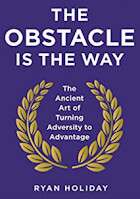
I recently read The Obstacle is the WAY: The Timeless Art of Turning Trials into Triumph by Ryan Holiday (2014).
I didn’t realize it until the very end of the book, but RH was really describing Stoicism. Interesting that I’ve never thought of myself as Stoic, but clearly, I have some Stoic tendencies. That, I think, is a generally good thing.
My top takeways:
-Difficulty and crisis make us better, or worse. It all depends on how we respond to them.
–NOT panicking is a learnable skill, and a quite necessary one. It is fundamental to the training of astronauts.
-Emotion almost never has the power to change a condition or circumstance.
-Things that are in my control (assuming I choose to): Emotions, judgements, creativity, attitude, perspective, desires, decisions, and determination.
-Replacing fear with process is key to self-regulation (and organizational regulation).
-In truly important matters of strategy and deployment, have Plan A, and Plan B, and Plan C, and…
-Premortem is the act of exercising hindsight, in advance; an excellent strategy formulation technique.
My favorite quotes:
“…Andy Grove, former CEO of Intel…described what happens to businesses in tumultuous times: ‘Bad companies are destroyed by crisis. Good companies survive them. Great companies are improved by them.’” (p. 3)
“We must all either wear out or rust out, every one of us. My choice is to wear out.” – Theodore Roosevelt (p. 71)
“If you’re not humble, life will visit humbleness upon you.” – Mike Tyson (p. 140)
I thoroughly enjoyed this book. Confirmed much of what I already believed and gave me interesting insight into some areas that I had not considered.
*If you’d like to read more of nc’s blatherings, go to www.nelsonwcoulter.com