Category: Thought Leaders

  • BetterQuestions

    Good questions stimulate deep reflection, often unexpected insights, and occasionally, transformational breakthroughs. Not-so-good questions do none of that.

    What’s the difference?

    Not-so-good questions…

    • Offend others
    • Diminish others
    • Feel judgmental
    • Seem interrogational
    • Stymie meaningful exchange

    Impactful questions…

    • Invite deep reflection
    • Lead toward new insight
    • Convey value in participants
    • Generate safe and productive discourse
    • Accelerate learning (individual and collective)

    It’s not the question mark (?) that holds the magic. The intention of the inquirer makes all the difference. It starts with an assumption of…

    “There seems something here we don’t fully understand, and might be able to learn together.”

    *If you’d like to read more of nc’s blatherings, go to nc’s Recursive Learning.

  • Gratuity

    Most of us tip the server when we visit a restaurant. That gratuity is a simple expression of appreciation for service rendered.

    Gratuity is a powerful force multiplier, and it need not be limited in its scope. We can acknowledge and honor the effort and commitment of others in MANY ways, both tangible and intangible.

    Consider some common and impactful gratuitous enactments:

    • Embody respectfulness.
    • Say thanks, often and personally.
    • Be hyper-aware of the efforts and struggles of others.
    • Read and freely share the stories of iconic servant leaders.
    • Start meetings and engagements with expressions of thanks.
    • Reflect on our blessings, especially in the context of human history.
    • Donate — time, money, effort — to some kind of humanitarian cause.
    • Improve constantly, as result of lessons learned and noble intentions envisioned.

    We’re all only visiting this planet. Extending gratitude is a way to make that visit much more pleasant, for ourselves and for all those whose paths we cross.

    May the Force………………………………..get multiplied.

    *If you’d like to read more of nc’s blatherings, go to nc’s Recursive Learning.

  • MATTERing

    Some folks just give in, give up, choose the myopic and self-centric view, opt for pessimistic inertia. Being but one person on a planet populated by 8 billion humans, they take the view that we are but one grain of sand on a very large beach. How can/could we matter?

    On the other hand…………

    A different kind of folks choose to matter. They work to make themselves, and “things,” better. They understand that hope is lovely, but insufficient. Making a better future takes intentional effort.

    MATTERers follow a fairly common and simple recipe. They zealously choose to:

    • Believe – in something bigger than themselves, and constantly seek to clarify and make sense of that grounding-guiding “vision.”
    • Share – with others, both like minded and not, those consequential beliefs.
    • Care – for themselves, for others, for the planet and universe with which we have been blessed.
    • Serve – in many ways, with eyes and hearts outwardly directed.
    • Start – now, in this moment, today, and every day hereafter.
    • Focus – on their respective spheres of influence, however small or large.

    Yeppers. The key and repeated verb from above is “choose.” Now is a good time to start.

    *Warning: There is no end in sight. Bettergetting and Bettermaking are daily disciplines.

    *If you’d like to read more of nc’s blatherings, go to nc’s Recursive Learning.

  • BounceLesser

    I engaged an 84-year old cowboy (Ben) in conversation during a luncheon not long ago. Ben was an interesting character, with bright eyes and a quick wit. He had been a working cowboy his entire adult life and a ranch manager for over 40 years.

    Ben told me that he had “recently” quit breaking horses because he “didn’t seem to bounce” like he used to. WHAT!?, I thought. Still breaking colts (and getting bucked off) in his 80s???

    Though age (and wisdom) had called upon Ben to adjust his behavior and thinking to account for the realities of life, he was still exhibiting curiosity, vim, and vigor. He was, however, wisely aware that changing contexts require us to adapt.

    A good lesson for us all: Get better at adapting to evolving realities/contexts. But never quit contributing and serving.

    How best can I continue to “bounce,” even when some of the former “bounciness” is not available to me?

    *If you’d like to read more of nc’s blatherings, go to nc’s Recursive Learning.

  • WisdomPursuit

    According to leadership guru Dan Rockwell, “Wisdom is practical know-how. (Nothing more, nothing less, nothing else.)”

    From observing others over the years it appears to me that wisdom gatherers fall into three categories:

    Happenstancers – With this group, little morsels of wisdom “stick” on and to them as result of simply living life.
    Attenders – This group shows up for “class” every day. They take the trouble to actually pay attention. They watch, they learn, and they apply the learning when appropriate. Their wisdom grows incrementally. They are present, and accounted for.
    Seekers – This group adopts and embraces the HABITS of wisdom acquisition. They read purposefully, they watch intently, they tinker persistently, they listen deeply, they relentlessly engage with many wise others (across learning disciplines), they are on a continuous mission of “connecting the dots.” They have learned the financial lesson of “compounding interest” and apply it adeptly to their wisdom “savings accounts.” In short, their “nutrition” is LEARNING and their “exercise” is the application of that LEARNING.
    You know the next question…

    *If you’d like to read more of nc’s blatherings, go to nc’s Recursive Learning.
    FacebookTwitterEmailShare

  • LeadThink

    Those in leadership roles frequently feel the burden of that responsibility. It is real! To whom much is given, much is required.

    Being the best leaders we can be requires us to spend some of our personal resources on self-care. If WE are not healthy and well, what makes us think we can lead entire organizations toward health and wellbeing?

    From my observations of some particularly “well” leaders over the years, I deduce common forms of Leader Think in which they engage.

    Particularly “well” leaders…

    • Hold zealously to their principles.
    • Remain relentlessly committed to acts of service.
    • Doggedly pursue continuous improvement, personal and collective.
    • Engage in disciplined “exercise”_intellectual, physical, and emotional-spiritual.
    • Ask excellent questions, grounded in curiosity and in relationship building.
    • Engage and meaningfully connect with many others.
    • Model and expect respectful behavior.
    • LEARN daily.

    How leaders think is how leaders lead.

    *If you’d like to read more of nc’s blatherings, go to nc’s Recursive Learning.

  • FutureDriven

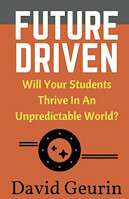
    I recently read Future Driven: Will Your Students Thrive In An Unpredictable World? by David Geurin (2017).

    Collegiate Edu-Nation

    This book was as much about pedagogy and engagement as it was about affecting future- and life-ready students. But, of course! Are those not inextricable entanglements?

    My biggest takeaways:
    ·      NEVER…………delay gratitude.
    ·      In schools, desks in rows is “the cemetery effect.”
    ·      In learning task design, avoid the trash can finish.
    ·      Learning task designer is the teacher’s premier role.
    ·      If we can’t change our mind, we can’t change anything.
    ·      Could I sell tickets for my lessons? (Are they that good?)
    ·      Writing improves our thinking; thinking improves our writing.
    ·      Unless we can do something useful with our learning, it is meaningless.
    ·      People complain about two things: 1) The way things are, and 2) Change.
    ·      If everyone in my workplace had my attitude, what kind of place would it be?
    ·      Embed the standards in the learning; don’t let the standards BE the learning.
    ·      Charles Schultz: “Life is like a 10-speed bike. Most of us have gears we never use.”

    My favorite quotes:
    “A person who feels appreciated will always do more than is expected.” (p. 46)

    “If our students master every standard but do not discover joy and passion in learning, we have failed them.” (p. 64)

    “The cure for boredom is curiosity. There is no cure for curiosity.” – Dorothy Parker (p. 65)

    “We don’t learn from experience, we learn from reflecting on experience.” – John Dewey (p. 106)

    “Education without values, as useful as it is, seems rather to make man a more clever devil.” —C.S. Lewis (p. 179)

    A good read for educators. An excellent book for team studies.

    *If you’d like to read more of nc’s blatherings, go to nc’s Recursive Learning.

    FacebookTwitterEmailShare

  • ReflectiveBetterment

    Getting better. On purpose. Every day.

    Easier said than done. But it always starts with reflection. It’s hard to purposefully move toward improvement (either personal or collective) until/unless we turn the mirror on ourselves. That mirror-gazing is both a look at what exists in this moment, and a look over the shoulder at where we’ve been.

    WHY – Why have we thought and acted as we have been? Are those moves in alignment to where we want to go and what we want to be in the future?

    WHAT – What needs to change today to bring us into that alignment? Some “stuff” likely needs to be halted, and other “stuff” needs to be ramped up.

    HOW – Knowing the WHAT leads to the HOW. The required changes in habits don’t occur on good intentions. Action of some kind is required. We need to be clear about how we intend to make those moves.

    WHEN – We can’t eat the whole elephant in one bite, but we can move the needle a little today (how’s that for mixed metaphors?). NOW is the time.

    GO! (Tomorrow we can re-evaluate and revise as needed. It’s sort of like continuous improvement.)

    *If you’d like to read more of nc’s blatherings, go to nc’s Recursive Learning

  • SpeedVsAccuracy<>WHY

    When we create targets — goals, outcomes, expectations — in life or work, we are faced with a series of decisions about how to hit those targets.

    Most of those decisions fall into one of two categories:

    Speed — How fast and with what intensity are we going to pursue those outcomes?

    Accuracy — What variability in achievement/performance levels are we willing to tolerate?

    Increased Speed almost always means decreased Accuracy. Increased Accuracy almost always translates into decreased Speed.

    Knowing WHY we have chosen the targets is the starting point. When we are very clear about WHY we are trying to achieve whatever it is we deem worthy of our time, effort, and resources, then it’s easier to find the right balance between the Speed at which we pursue it and the Accuracy tolerances we are willing to accept.

    If we don’t know the WHY, then neither Speed nor Accuracy matter much — unless all we’re doing is checking off boxes and writing reports.

    *If you’d like to read more of nc’s blatherings, go to nc’s Recursive Learning.
    FacebookTwitterEmailShare